
Spark Plasma Sintering
Retech has teamed up with GeniCore to represent their Spark Plasma Sintering (SPS) technology in the North American market. Spark Plasma Sintering (SPS) technology, also called Field Assisted Sintering Technology (FAST), enables effective consolidation of pure metal powders, metal alloys, as well as ceramic and metal composites using pulsed direct current.
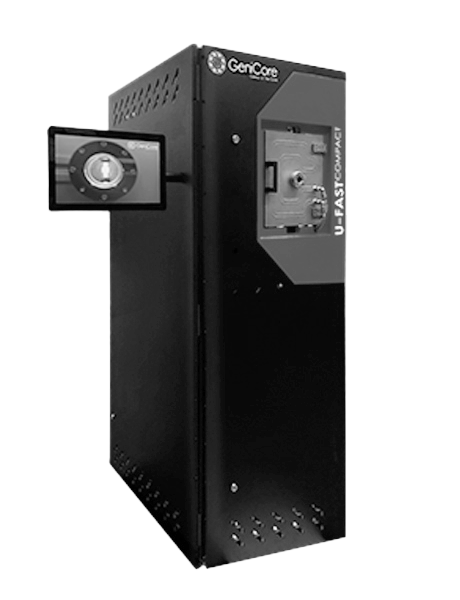
U-Fast-Compact
The same functionality as the U-FAST GC, but smaller. Intended for scientific institutes and universities.
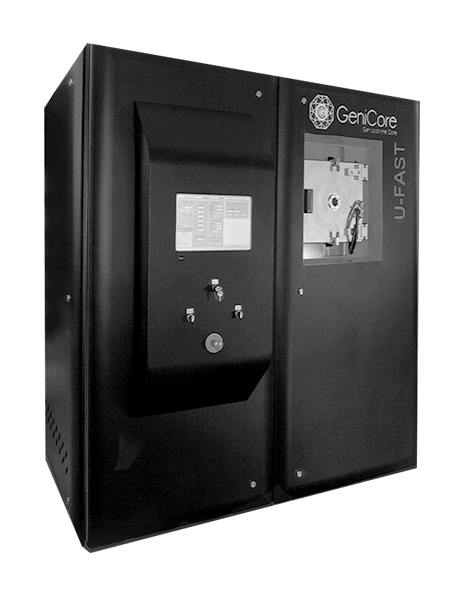
U-Fast-GC
The GeniCore U-FAST GC model is perfect for R&D, developing with new materials, and small batch production.
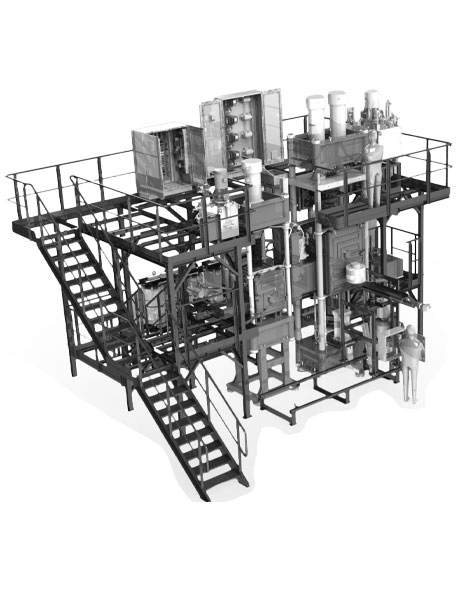
U-Fast-Hybrid
GeniCore’s U-FAST Hybrid sinters larger parts than conventional SPS by combining two different heat sources in one unit.
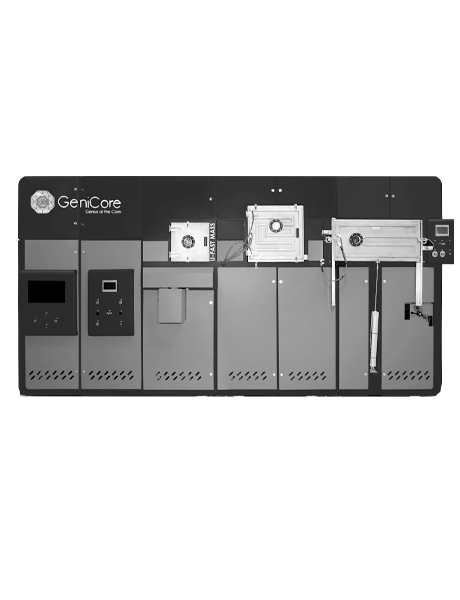
U-Fast-Mass
U-FAST MASS is GeniCore’s fully automated continuous Spark Plasma Sintering process for mass production.
GeniCore U-FAST Sintering Machines
U-FAST from GeniCore – is a state-of-the-art sintering machine that represents:
- The shortest pulses available on the market – below 1 ms.
- Scalable technology at a high vacuum
- Multi – point temperature measurements 0 – 2500 ℃
- Service and maintenance
- Single button – user friendly, automatic and intuitive control
- Sinter diameters up to 300 mm

GeniCore's U-FAST Sintering
GeniCore’s systems are based on SPS / FAST (Field Assisted Sintering Technology), where powder materials are consolidated at solid state under pressure with the aid of very short electric current pulses, producing high heating rates and enabling full densification at lower temperature with limited grain growth.
GeniCore’s U-FAST machines deliver ultra-short current pulses (below 1 ms) allowing for extremely fast energy delivery, which minimizes the exposure time of the material to high temperatures. This is crucial for preserving the nanostructure and limiting grain growth. Longer pulses can lead to local overheating and uncontrolled grain growth.
The machines support a wide materials range: metals (Fe, Cu, Al, AuAg, Ni, Cr, Mo, Sn, Ti, W), carbides (SiC, TiC, ZrC, WC), ceramic oxides (Al₂O₃, ZrO₂, TiO₂, MgO), borides (TiB₂, ZrB₂, VB₂), nitrides (TaN, TiN, ZrN), high-entropy alloys, thermoelectrics (e.g., PbTe), transparent ceramics, amorphous alloys, composites with ceramic matrices, and more.
-
- Compact: R&D scale, development of new materials (smaller parts).
- GC: R&D to small-batch production, somewhat larger capacity.
- Hybrid: For larger parts (up to ~200 mm diameter), uses SPS + induction heating to maintain uniform temperature distribution.
- MASS: Fully automated, continuous production machine, for large-scale industrial production.
- U-FAST Glovebox: For oxygen-/moisture-sensitive materials; inert-atmosphere R&D and small-batch production.
Yes — GeniCore emphasizes modular architecture. For example, in the Glovebox variant “U-FAST Glovebox (GC)” they note you can upgrade from GC55 to GC85-HV without replacing the base system. In general, the product pages mention modular upgrade paths.
-
- Much shorter sintering times (thanks to rapid heating via pulses)
- Much lower sintering temperatures (thank to short current pulses)
- Reduced grain growth (benefitting mechanical/optical properties)
- Energy efficiency — because electrical pulses heat the tooling and powder directly, not the entire furnace volume.
The technology is used in tooling, mining, SMRs, advanced electronics, luxury goods, additive manufacturing feedstock, thermoelectrics, optical lenses, transparent ceramics, piezoceramics, high-entropy alloys, high temperature ceramics, and more.
-
- The machine requires colling system (chiller) and inert-gas systems (in many cases) for best results (especially for sensitive materials).
- Die tooling (often graphite molds) is required, especially in SPS processes.
- For large part sizes, cooling and temperature uniformity become critical — e.g., in the Hybrid system the cooling stage is a key design consideration.
Temperature is measured by pyrometers (with optional thermocouples) and controlled via PLC logic with programmable multi-step heating profiles.
The sample diameters up to about 200 mm for the Hybrid, and for other models smaller sizes.
For the U-FAST MASS, for example, the vacuum system is designed to achieve operational vacuum in ~60 seconds via a 3-chamber design.
-
- While many materials are supported, you must consider tooling (dies), electrical connection, vacuum/inert atmosphere, and process parameters.
- Large diameters may require additional heating and cooling strategies (as noted in Hybrid model).
- The upfront investment and infrastructure (vacuum/inert gas, water cooling, power supply) may be higher compared to very simple setups, though the operational benefits often outweigh this.
Key factors include: desired part size/diameter, throughput (R&D vs production), choice of material (sensitive vs tolerant), budget and infrastructure, upgrade path, plus whether inert atmosphere or glovebox integration is required. Retech (as the North America representative) can assist with selecting the appropriate model, upgrade path, and support.